Agile Public Crisis Management — Is It Possible?
Agile and public crisis management share more than you might think. Using the Cynefin framework to see where agile principles actually help.
It is a debatable topic to explore agile in terms of public crisis management. Agile management and public crisis management have at least one thing in common: both are mostly used in situations with low predictability of future events. But it also raises questions:
- Is there anything else they have in common?
- Could crisis managers learn from agile management principles?
The Cynefin Framework
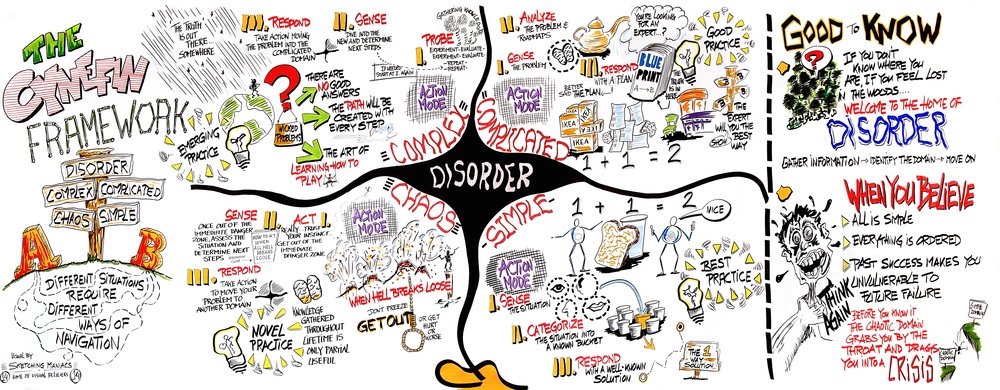
There is a model that is quite helpful to determine what kind of management approach fits certain problems: the Cynefin Model. It divides all situations into five context domains:
- Simple / Obvious — The relation between cause and effect is known. Best practices exist. Problems can be sensed, categorized, and responded to (SCR).
- Complicated — More expertise is needed to understand cause and effect. Good practices may exist. Problems should be sensed, analyzed, and responded to (SAR).
- Complex — The relation between cause and effect can only be understood retrospectively. No single right answer. The only way forward is to probe, sense, and respond (PSR).
- Chaotic — Cause and effect are completely unclear. You must act, sense, and respond (ASR).
- Disorder — No other context type applies. The first step is moving the situation toward a known context.
Agile management is most at home in complex contexts — where continuous improvement through retrospective analysis fits the PSR pattern well.
Is a Crisis Complex or Chaotic?
A crisis can be defined as a situation that is:
- Unexpected
- Creates uncertainty
- A threat to important goals
This places a crisis at least in the complex domain, if not chaotic or disordered. It cannot be obvious — otherwise it would not be unexpected. It cannot be merely complicated — an expert would have anticipated it.
The question then becomes: can we find a relation between cause and effect in retrospective analysis during a crisis?
For something like the COVID-19 pandemic, several countries raised radical countermeasures and later observed reduced infection rates — likely causal, but without proof. Other crises — like economic crises — allow clearer retrospective cause-and-effect analysis.
Current Crisis Management Structure
Crisis management in Germany is organized in structures inspired by the fire department, military, and civil protection organizations. These have a clear hierarchy where supervisors give orders downward. The agile world proclaims flat hierarchies — this is a real tension.
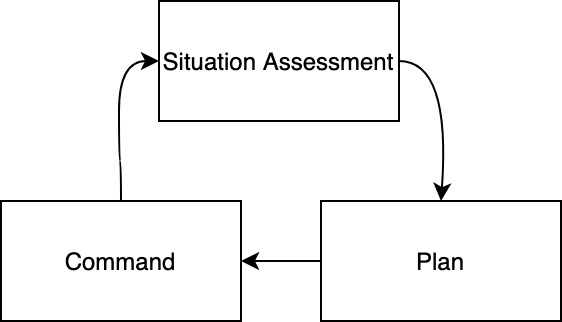
However, the management cycle of these organizations is strikingly similar to the agile PDCA (Plan-Do-Check-Act) pattern:
- Situation assessment: exploration of the situation, control of command effects
- Planning: evaluation, decision about actions
- Command
This continuous cycle of adjustment based on new information is essentially the same loop as an agile sprint retrospective applied in real-time.
Conclusion
Agile management and public crisis management are less different than they appear. Both operate in unclear situations with unpredictable decision outcomes. The management mechanics are similar — except for the hierarchical structure that crisis management requires for coordination at scale.
The insight: crisis management could benefit from more explicit retrospectives and probe-sense-respond thinking, while the agile world could learn something from civil protection's clear role definition and command discipline when speed matters most.
Stay in the loop
New posts on AI transformation, agile organizations, and electromobility.
Frequently Asked Questions
Can agile frameworks be applied to government crisis management?+
Agile principles — short cycles, fast feedback, and adaptive planning — apply well to the 'complicated' and 'complex' domains in the Cynefin framework, which describes most crisis situations. Governments already use elements of this, though rarely under the name 'agile'.
What is the Cynefin framework?+
Cynefin is a decision-making framework that categorises problems into five domains: obvious, complicated, complex, chaotic, and disorder. It helps leaders choose the right response style — best practice, expert analysis, experimentation, or rapid stabilisation — depending on the nature of the situation.
What is the difference between agile and traditional crisis management?+
Traditional crisis management relies on pre-defined procedures and top-down command structures. Agile crisis management emphasises distributed decision-making, rapid iteration, and continuous feedback — approaches that prove more effective when the situation is genuinely novel or fast-changing.